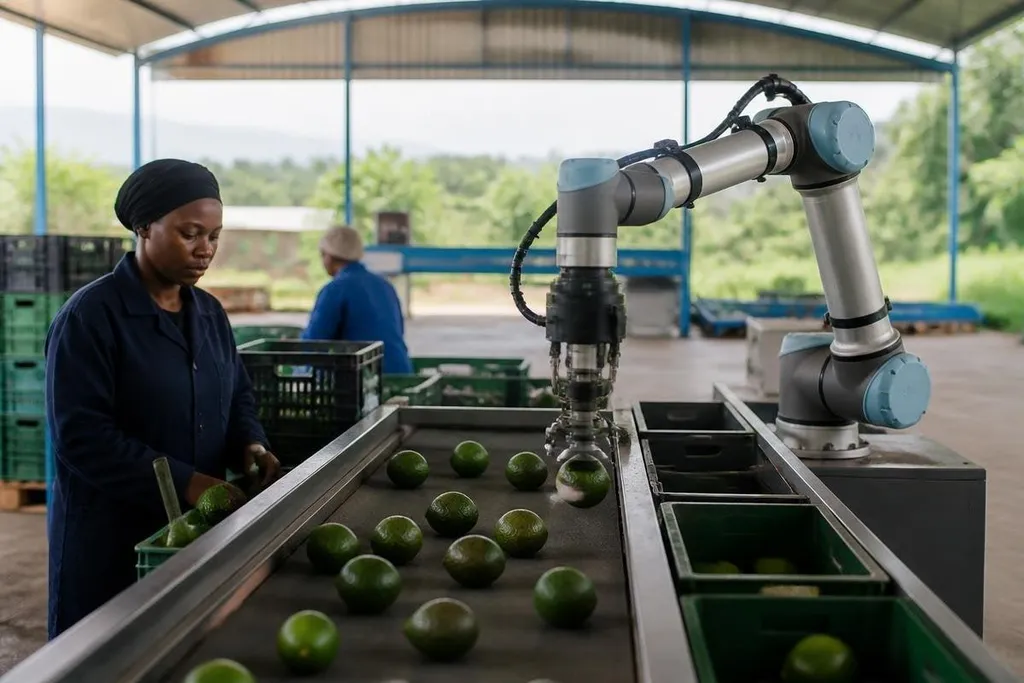
A robot does not need a human shape to change a local economy. A low-cost arm that sorts crops, a mobile unit that carries supplies, or an inspection drone may solve a clearer problem than a machine built to copy a person.
For governments, factory owners, and service operators, the question is practical: which jobs can robots do at a cost that fits local wages, power supply, roads, and repair skills?
- Small machines can fit work that already has a clear task and repeatable steps.
- Local repair, spare parts, and training may matter more than the robot’s top speed.
- The first gains may come from safer work and steadier output, not mass job replacement.
Start with tasks, not robot types
Performance is steadier when the task stays within known limits. Moving boxes across a short path, checking a fixed part with a camera, or dispensing a set amount of material gives the control system fewer surprises than work in a crowded street or changing field.
That matters in economies where firms may have limited cash for new equipment. A machine tied to one clear job can be priced against that job’s labor, errors, injuries, downtime, and output. A humanoid robot has to justify a wider set of hardware, sensors, software, and safety systems before its business case becomes clear.
The same rule applies outside factories. A small autonomous system could carry medicine across a hospital site, inspect a water pipe, or move goods between buildings. Each use needs a local check: does the robot save enough time or reduce enough risk to cover its purchase, power, service, and training costs?
Where local conditions decide the result
Electricity is part of the machine. A robot that needs steady power and a clean network may work well in one industrial park and fail in a rural clinic. Backup batteries, manual controls, and simple charging equipment can matter more than extra degrees of freedom, which means extra ways for the machine to move.
Repair is another limit. If a damaged motor or camera must travel across a border, a small fault can stop the whole system for weeks. Local technicians need access to manuals, diagnostic tools, spare parts, and training. Without that support, the robot becomes an imported service contract rather than a useful production tool.
Data also needs care. Sorting, delivery, and inspection systems may collect images of workers, homes, or public spaces. Clear rules should say who owns that data, how long it stays stored, and when a person can review a machine’s decision.
A job title can hide the real change: a robot may remove lifting while leaving monitoring and repair with people. Reports on robotics deployments record that split at a named site, leading into the next section on jobs that change before they disappear.
Jobs will change before they disappear
Automation can remove parts of a job without removing the whole job.
A robot may lift a heavy load while a person checks quality, handles exceptions, or speaks with a customer. That shift can reduce injuries and let one worker manage more output, but it can also change the skills a workplace needs.
Training decides who gets the new work. A technician who can wire sensors, read fault codes, or replace a drive motor may find a new role. A worker whose task is reduced to one repeated step may need paid time to learn something else. The result depends on who pays for that training and who gets access to it.
I’d put repair skills ahead of humanoid form when public money is involved. A machine that local teams can fix has a better chance of staying useful after the launch event ends.
A practical test for new projects
Before buying or funding a robot, check the following points:
- Name the task: write down the exact movement, load, speed, and work hours the machine must handle.
- Price the full system: include power changes, software, safety gear, training, repairs, spare parts, and downtime.
- Test the local setting: run the machine with the real floor, dust, heat, network, lighting, and shift pattern.
- Set a human fallback: decide who takes control when a sensor fails, an object moves, or the network drops.
- Measure the result: compare output, injury risk, maintenance time, and worker pay before and after the trial.
- Plan the next five years: ask who will service the robot and what happens when its supplier stops supporting the model.
These checks point toward a slower form of adoption. A farm, clinic, port, or workshop may start with one narrow system, learn its repair needs, then add another only when the first one works in daily conditions.
The open question is not whether developing economies will use robots. It is whether the machines will be chosen around local work and local skills, or bought as sealed products that leave when the first repair bill arrives.